
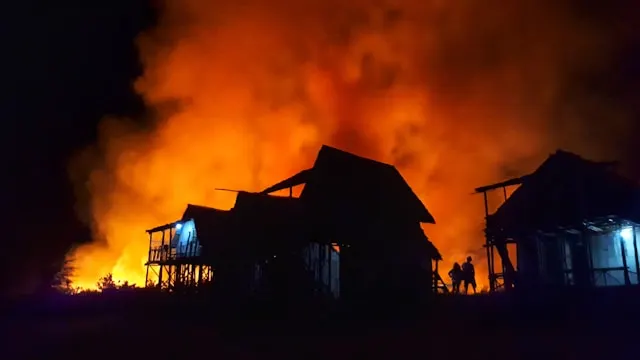
A House Fire Changes Everything — But Does Medicare Help?
A house fire is one of the most overwhelming experiences a person can face. In a matter of hours, you can lose your home, your belongings, and your sense of security. Amid all the chaos, you may be wondering: will my Medicare cover me?
The short answer is: Medicare covers your health and medical care — but not your property. Understanding this distinction is important so you know exactly what to expect and where to turn for help.
At Mere Benefits, we believe you deserve clear, honest answers — especially during life's most stressful moments. This guide will walk you through exactly what Medicare covers after a house fire, what it does not cover, and what steps you should take right away.
What Is Medicare — and What Is It Designed to Do?
Before we talk about house fires specifically, it helps to understand what Medicare is built to do. Medicare is a federal health insurance program primarily for people aged 65 and older, as well as some younger individuals with qualifying disabilities.
Medicare is designed to help pay for your medical and health care needs. It is not a homeowner's insurance policy, a disaster relief program, or a property coverage plan. Here is a quick breakdown of the main parts of Medicare:
Medicare at a Glance
- Part A — Hospital insurance: covers inpatient hospital stays, skilled nursing, and hospice care
- Part B — Medical insurance: covers doctor visits, outpatient care, preventive services, and ambulance transportation
- Part C — Medicare Advantage: a bundled plan offered by private insurers that combines Part A and Part B
- Part D — Prescription drug coverage: helps pay for prescription medications
Each part plays a different role. After a house fire, some parts of Medicare will be very relevant to your situation — and others will not apply at all.
Related: How Medicare Advantage Plans Work — Mere Benefits Guide
What Medicare Does and Does Not Cover After a House Fire
This is the most important section. Let's look at each part of Medicare and whether it applies to a house fire situation.
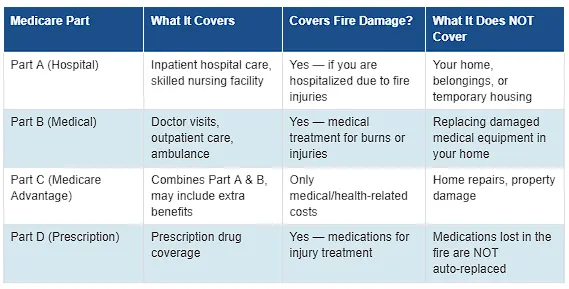
The key takeaway: Medicare will cover your body, not your belongings. If you are hurt in a fire, Medicare is there for you. If your home is destroyed, you will need to look elsewhere for help.
Medicare Does Cover These Fire-Related Medical Situations
If a house fire causes you physical injury or a medical emergency, Medicare can step in to help cover those costs. Here are the situations where Medicare will most likely apply:
- Emergency Room Visits and Hospitalization: If you or a family member needs emergency treatment for burns, smoke inhalation, or other injuries sustained in the fire, Medicare Part A and Part B will generally cover those costs — after your deductibles and copays.
- Ambulance Transportation: If an ambulance is needed to transport you to a hospital, Medicare Part B typically covers medically necessary ambulance services.
- Burn Treatment and Wound Care: Ongoing outpatient treatment for burns, including specialist visits and wound care services, is generally covered under Medicare Part B.
- Mental Health Support: A traumatic event like a house fire can have real effects on your mental health. Medicare covers mental health services, including visits with therapists and psychiatrists.
- Prescription Medications: If you need new prescriptions to treat fire-related injuries, Medicare Part D will cover those medications. However, there is an important note about lost medications — more on that below.
What About Lost or Destroyed Prescription Medications?
This is one of the most common questions we hear at Mere Benefits, and it is an important one.
If your prescriptions were destroyed in the fire, Medicare Part D does not automatically allow you to refill them early. Most Part D plans have a standard refill schedule, and getting an early refill can be complicated — especially in the middle of a crisis.
Here is what you should do right away if your medications were lost in a fire:
- Call your Part D plan directly and explain the situation. Many insurers will make an exception for disaster-related losses.
- Ask your doctor to contact the pharmacy on your behalf. A prescriber's note can help speed up the process.
- Check if your state has a disaster exception policy — many states allow early prescription refills during declared emergencies.
- Keep a record of everything: your policy number, the medications you lost, and any communications with your insurer.
Acting quickly and keeping good records will make a big difference in how smoothly this process goes.
Related: Understanding Medicare Part D: Prescription Drug Coverage Explained — Mere Benefits
What Medicare Does NOT Cover After a House Fire
Let's be equally clear about what Medicare will not cover, so there are no surprises when you need help most:
- Home repairs or reconstruction — Medicare is not homeowner's insurance. Any structural damage to your home is not covered.
- Temporary housing or hotel stays — If you need to stay somewhere while your home is repaired, Medicare does not pay for that.
- Replacement of personal belongings — Furniture, clothing, electronics, and other possessions lost in the fire are not covered by Medicare.
- Replacement of durable medical equipment lost in the fire — If your wheelchair, CPAP machine, or other DME was destroyed, Medicare may not automatically replace it. You will need to work with your doctor and supplier.
- Food or daily living expenses — Any general disaster relief costs are not part of Medicare's scope.
For property-related losses, your homeowner's or renter's insurance policy is the right place to look. If you do not have one, FEMA and local disaster relief organizations may also be able to help.
What About Medicare Advantage Plans — Is There Any Additional Help?
If you are enrolled in a Medicare Advantage (Part C) plan, you may have access to some extra benefits that a standard Medicare plan does not offer. Some Medicare Advantage plans include:
- Meals delivered to your home during recovery
- Transportation to medical appointments
- Non-medical in-home support services
- Mental health resources and counseling programs
These extra benefits vary by plan and by insurer. This is exactly why Mere Benefits recommends reviewing your plan's benefits booklet carefully — or calling us so we can help you understand what your specific plan includes.
Related: How to Compare Medicare Advantage Plans in Your Area — Mere Benefits
Important Steps to Take Right After a House Fire
If you or a loved one has been through a house fire, here is a simple checklist to follow when it comes to your Medicare coverage and health care needs:
Your Post-Fire Medicare Action Checklist
- Seek medical attention immediately — even if injuries seem minor. Smoke inhalation can have delayed effects.
- Call 911 or go to the emergency room if needed. Medicare Part A and Part B will cover emergency care.
- Contact your Part D plan about lost medications and request a disaster exception for early refills.
- Notify your primary care doctor so they can coordinate your ongoing care and prescriptions.
- Contact your Medicare Advantage plan (if applicable) to ask about any additional disaster-related benefits.
- Document everything — photos, receipts, medical records — for both your insurance claims and Medicare purposes.
- Reach out to Mere Benefits for help reviewing your coverage and understanding your next steps.
Focus: Why Knowing Your Medicare Coverage Before a Crisis Matters
This is the heart of what Mere Benefits wants every Medicare enrollee to understand.
Most people think about their Medicare coverage only when they need it — and that is completely natural. But the moments when you need it most are often the most stressful, chaotic, and emotionally overwhelming moments of your life. A house fire is exactly that kind of moment.
When you already understand what your plan covers, you can move faster, make better decisions, and avoid costly mistakes. You will know when to call your insurer, when to ask your doctor for help, and when to look outside of Medicare for support.
At Mere Benefits, our focus is on helping you understand your Medicare coverage before you need it — so that when life throws the unexpected at you, you are not scrambling to figure it out from scratch. That is what we mean by being simply for your benefit.
Other Resources That Can Help After a House Fire
Medicare is one piece of the puzzle. Here are other resources worth knowing about:
- FEMA (Federal Emergency Management Agency): Provides disaster relief assistance including temporary housing, grants, and low-interest loans for those affected by declared disasters. Visit disasterassistance.gov.
- American Red Cross: Offers immediate disaster relief including emergency shelter, food, and basic supplies.
- State Medicaid Programs: If you have both Medicare and Medicaid (dual eligible), additional support may be available to help with costs not covered by Medicare alone.
- Local Nonprofit Organizations: Many communities have local agencies that provide additional support during disaster recovery.
Final Thoughts: Medicare Is There for Your Health — Know What Else You Need
A house fire is a painful reminder that life can change in an instant. The good news is that if you have Medicare, your medical care is protected. Emergency treatment, hospitalization, burn care, mental health support, and prescription coverage are all available to help you recover.
What Medicare cannot do is replace what you have lost at home. For that, you need a solid homeowner's or renter's insurance policy alongside your Medicare coverage. Understanding how these two forms of protection work together — before a crisis happens — is one of the most empowering things you can do for yourself and your family.
At Mere Benefits, we are committed to helping you navigate Medicare with confidence. If you have questions about your coverage, your plan's benefits, or how to prepare for unexpected events, we are just a phone call away.
Need Help Reviewing Your Medicare Options?
At Mere Benefits, we're here to help you understand exactly what your Medicare plan covers — especially during unexpected life events like a house fire.
Call our office if you would like help reviewing your options.
📞 904-654-5450
#simplyforyourbenefit

Founder & Licensed Insurance Agent at Mere Benefits — RSSA®, CMIP®. Independent, no-pressure guidance across Northeast Florida & Camden County, GA. This article is educational and not medical, tax, or legal advice.
Questions about your own situation?
Kate can turn this into a specific answer for you — free, and with no pressure.